
Parkour vs Freerunning

Parkour and freerunning are two very similar sports that approach movement very differently. When researching one, you are likely to come across the other, which often begs the question: What is the difference between parkour and freerunning?
Parkour is a sport that involves navigating from one point to another in the most efficient manner. It is typically performed in urban environments and involves vaulting, climbing, or jumping over and around natural obstacles. On the other hand, freerunning focuses on the theatrics of movement. Instead of simply getting from point A to point B, it incorporates tricks and flips. This sport focuses on creating aesthetically pleasing combos, using traditional parkour runs as a foundation for self-expression.
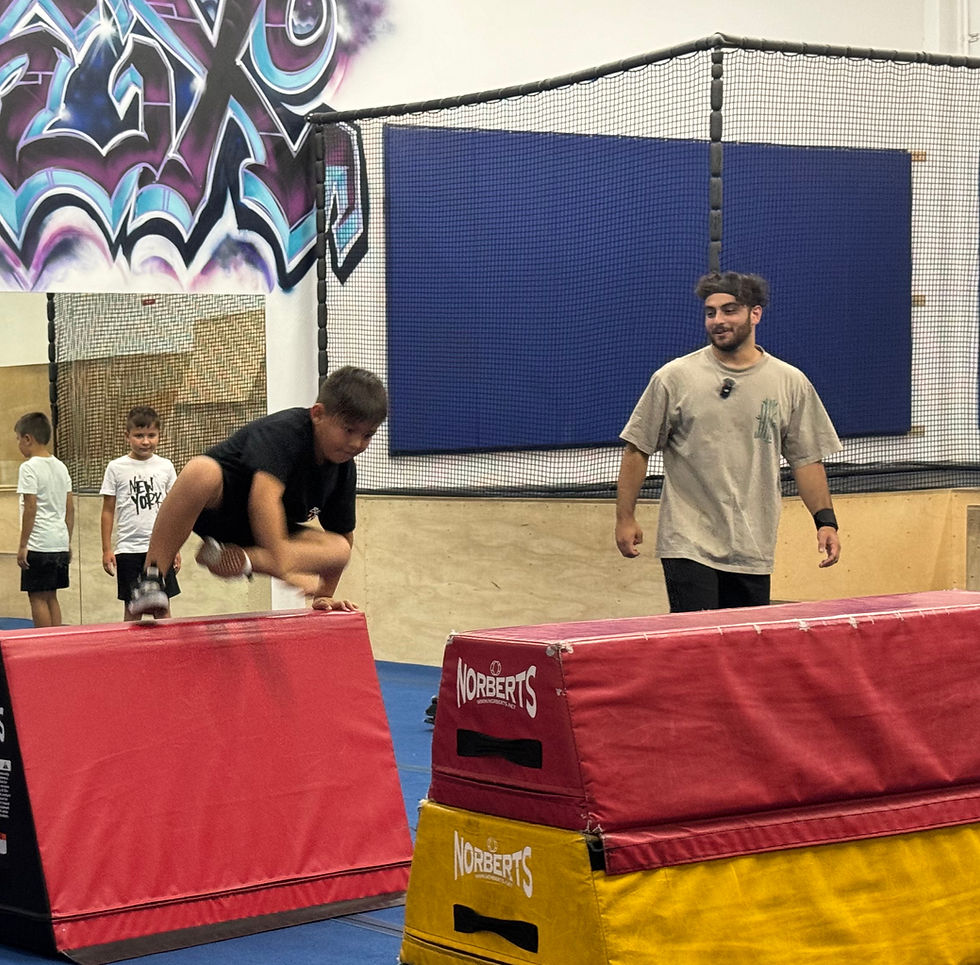
Vortex Freerunning uses both parkour and freerunning as a tool to nourish the physical and mental development of Southern California’s youth. We offer various classes, programs, and hands-on guidance to help kids surpass their limits, allowing them to conquer their fears through dynamic and exciting movements.
To schedule your first class or sign up for a membership, please contact us online.

About Freerunning
Freerunning is a sport that navigates urban environments with your only limits being your physical skills. (Johnson) Unlike parkour, freerunning incorporates more advanced and complex tricks and skill sets to showcase the aesthetics and artistry of movement. During runs, athletes typically combine movements such as flips, spins, and specialized jumps and drops when possible. Ultimately, freerunning utilizes flair and theatrics to showcase the body's capabilities. (Derakhshan and Machejefski)
How Freerunning Can Benefit Your Child
Freerunning offers several benefits when used as an extracurricular activity or a cross-training sport. Physically, this sport utilizes each muscle group simultaneously and enhances your child’s strength, agility, flexibility, body awareness, and overall motor function.
Freerunning can also lead to improvements in your child’s cognitive development. Freerunning exercises your child’s problem-solving skills as they navigate obstacles, but also allows them to express their creativity as they create exciting trick combinations and unique movement styles.
Signing your child up for freerunning may also elevate their self-esteem and confidence. Our classes are designed to promote a social environment, allowing your child to socialize amongst their peers and overcome new challenges, fears, and worries in a supportive environment.
Competitive Freerunning
Freerunning cannot only be practiced recreationally, but also competitively. Freerunning competitions allow athletes at both junior and professional levels to showcase their skills. Freerunning is considered more competitive than parkour and is often referred to as a style competition in many parkour competitions.
Competitive freerunning runs are judged by several different things. These include the difficulty of the moves being performed, the execution of each move, how smooth the landing is, as well as how long the run is. Athletes are also typically divided by age when competing.
Our Competition Team
At Vortex Freerunning, we have a youth competition team for those interested in performing higher level. Our team consists of children and teenagers aged 7-16 years old. Our team competes in up to ten competitions per season, with competitions being located throughout the West Coast. Throughout previous seasons, our team has had the chance to visit both Arizona and Oregon, as well as several cities across Northern and Southern California.
Parkour and Freerunning Classes in North Hollywood and Thousand Oaks
If your child is interested in freerunning, look no further than Vortex Freerunning! We offer several freerunning classes for children and teens of all ages. Our goal is to use the sports of parkour and freerunning to help inspire kids to be greater versions of themselves, both mentally and physically.
We offer memberships that include either one, two, or three classes a week. Each class offers a 1:6 coach-to-student ratio, ensuring your child gets personalized attention and focus. We also include skillset tracking so that each coach knows what your child has already mastered and what areas they may need improvement in. Our programs are designed to help your child set and reach short-term and long-term goals and milestones, with each one being tailored to a different age group and skill level. Each membership additionally offers unlimited access to our drop-in hours, which are supervised sessions where your child can practice their moves in their own time.
Freerunning Classes
We offer six different freerunning class levels at our gym. Each one is designed to continue upon the lessons of the last.
Level One: Level one is designed to teach your child about the foundation of movement and build their basic skills. It is centered on developing your child’s body control and balance.
Level Two: This level takes the fundamentals learned from level one and exercises them using real-world applications. Each child is introduced to obstacles and challenging runs in a new, engaging way.
Level Three: Our coaches begin teaching freerunning movements during this level. We begin with tricks such as backflip and front flips before moving on to more complex tricks and movements.
Levels four, five, and six are designed to expand your child’s skillset. Our coaches introduce more advanced tricks and combos, allowing your child to build upon their mastered abilities and push themselves to a more elite level.
If your kid is ready to get started, we invite you to sign up for a free trial class! If you have any questions or want to learn more about our classes, we encourage you to submit our online contact form.
References
Johnson B. Freerunning is blowing up social media, and you need to know all about it. Red Bull. Published March 9, 2022. https://www.redbull.com/us-en/freerunning-101-beginner-guide
Derakhshan N, Machejefski T. Distinction between parkour and freerunning. Chinese Journal of Traumatology. 2015;18(2):124. doi:https://doi.org/10.1016/j.cjtee.2015.07.001


Comments